
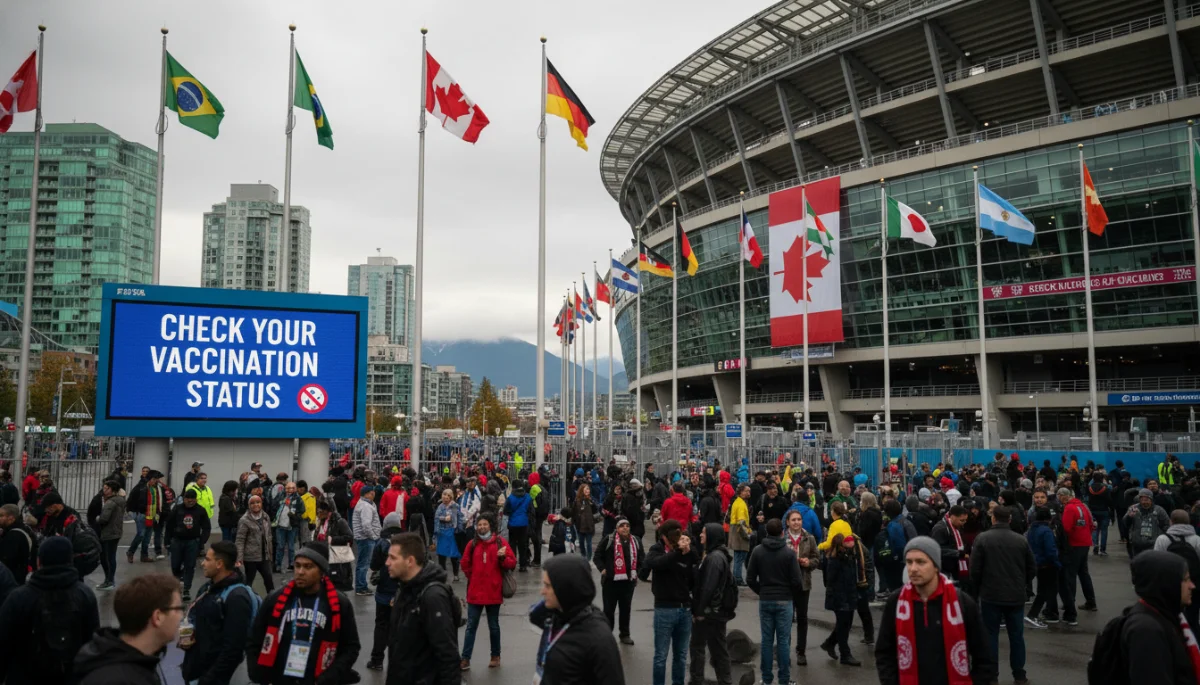

Health officials are urging caution as Vancouver prepares to welcome large crowds for an international soccer tournament that could bring measles into Canada from abroad. The concern is not about the event itself, but about what happens when thousands of travelers, fans, athletes, and staff move through crowded venues, airports, and hotels at the same time.
The Public Health Agency of Canada has flagged measles as one of the most likely illnesses to be imported during the tournament. That assessment reflects a simple reality: measles is still circulating in many parts of the world, it spreads with unusual ease through the air, and a major event creates plenty of opportunities for exposure.
- Why Officials Are Paying Close Attention
- Doctors Want Clearer Public Guidance
- The National Outbreak Is Still Ongoing
- Vancouver’s History Offers a Warning
- Health Authorities Say Planning Is in Motion
- Who Faces the Greatest Danger
- Canada’s Status Shows Why Prevention Matters
- What Residents and Visitors Should Take Away
Why Officials Are Paying Close Attention
Ontario has already released a detailed infectious disease risk review for the competition, and it points to the same pressure points public health experts have been watching for months. International travel, dense crowds, and uneven vaccination coverage can combine to raise the risk that one imported case becomes more than just a single illness.
British Columbia has not yet made its own public assessment available, which has drawn criticism from some infectious disease specialists. For them, the issue is not panic. It is transparency. The closer a city gets to a global event, the more important it becomes to tell residents what to expect and how to stay protected.
Doctors Want Clearer Public Guidance
Dr. Brian Conway, medical director of the Vancouver Infectious Diseases Centre, says the province should be speaking more directly to the public before tournament traffic reaches its peak. In his view, people should be reminded to check their measles vaccination status now, not after symptoms begin appearing.
He also believes visitors need to understand that Canada is already managing active measles spread in several regions. That message matters because many travelers assume North American health risks are low. According to Conway, a major event can change that equation if one infected person enters a crowded space filled with people who are not fully protected.
His concern is straightforward: the best time to prepare for a contagious disease is before the first wave of fans arrives.
The National Outbreak Is Still Ongoing
Canada has recorded more than 900 measles cases across seven jurisdictions this year, with Alberta and Manitoba accounting for the largest share. Those numbers show that the virus is not an abstract threat. It is already moving through communities.
The current outbreak follows an even larger surge last year, when more than 5,000 infections were reported nationwide. Public health investigators believe that earlier wave began after exposure outside Canada, underscoring how quickly an imported case can ignite broader transmission when the conditions are right.
In British Columbia, officials have reported 470 measles cases across 2025 and 2026. Roughly 80 percent of those infections have been concentrated in northeastern B.C., where immunization coverage is among the lowest in the province.
Vancouver’s History Offers a Warning
Experts are also looking back at what happened after the Vancouver 2010 Winter Olympics. In the months that followed, British Columbia experienced a measles outbreak that produced 82 confirmed cases. The situation is not identical to what Vancouver faces now, but it remains a useful reminder that large international events can create ideal conditions for infectious disease spread.
Dr. Conway says the risk is more complicated today because vaccination rates have slipped in parts of British Columbia. He also notes that some countries sending visitors to the tournament have lower immunization coverage than Canada, which increases the chance that an imported case could arrive with the crowds.
Health Authorities Say Planning Is in Motion
Vancouver Coastal Health says it has been preparing for the tournament for years and has already completed a public health risk assessment with the B.C. Centre for Disease Control. Even though the results have not been released publicly, the health authority says the work has helped shape its response planning.
Dr. Mark Lysyshyn, deputy chief medical health officer with Vancouver Coastal Health, said the assessment placed measles risk in the medium range during the event. He added that the region has already dealt with dozens of imported measles cases during the current outbreak, and those cases did not lead to ongoing local spread.
In his view, strong immunization coverage in the Vancouver Coastal Health region provides an important shield. Because of that, he does not expect a single imported case during the tournament to become unusually hard to manage.
The City Says It Is Ready for Disruptions
The City of Vancouver says it has broad operational and emergency plans in place for the event. City officials say they are prepared to respond quickly if public health concerns or other safety issues come up while the tournament is underway.
That kind of planning may sound routine, but it becomes more important when an event draws international attention and an unpredictable number of visitors into the same urban spaces.
Who Faces the Greatest Danger
Dr. Monika Naus, a professor at the University of British Columbia’s School of Population and Public Health, says any large gathering with international travel carries some infectious disease risk. Still, she emphasizes that the broader public is not equally vulnerable.
Most adults are already immune to measles through vaccination or prior infection, which keeps the overall risk relatively contained. The greater concern is for communities where immunization rates are low and the virus can move quickly once it gets in.
In British Columbia, those vulnerable pockets tend to be geographically clustered. That means an outbreak is less likely to spread evenly across the province and more likely to hit specific communities with lower protection.
Canada’s Status Shows Why Prevention Matters
The Public Health Agency of Canada said last year that the Pan American Health Organization informed Canada it had lost measles elimination status. That designation is revoked when transmission continues over a prolonged period rather than appearing only as isolated imported cases.
Canada can recover that status if measles transmission is interrupted for a full year. Until then, public health leaders are focused on keeping imported cases from turning into sustained chains of infection.
What Residents and Visitors Should Take Away
As the tournament nears, health experts say the most practical step is also the simplest: confirm measles vaccination records. For residents, that may mean checking childhood records or speaking with a health provider. For visitors, it means making sure they are protected before traveling to Vancouver.
Measles is highly contagious, but it is also preventable through vaccination. With global crowds expected in the city, that protection becomes even more important. The challenge for Vancouver is to enjoy the energy of a major sporting event without letting a preventable virus gain a foothold.