
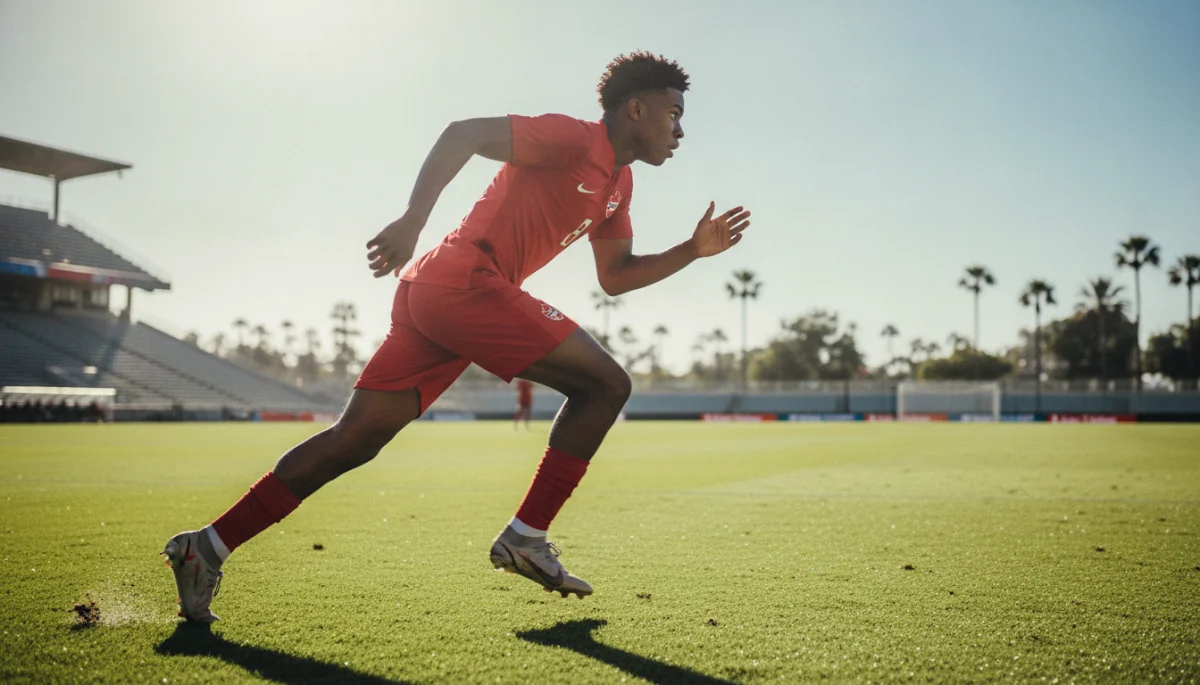

After weeks of anxious speculation surrounding Canada’s most celebrated athlete, the silence has finally broken. Alphonso Davies, the youngest captain in FIFA World Cup history and arguably the fastest left-back on the planet, is officially cleared to participate in the 2026 tournament. His return marks a pivotal turning point for the Canadian national team, which has navigated the early stages of the group play without its most dangerous offensive weapon. The 25-year-old star, who has been regenerating through a grueling recovery process, is set to make his debut when Canada faces South Africa at SoFi Stadium in Inglewood, California. This afternoon match at 3 p.m. ET represents the culmination of a nine-month journey that began with a devastating ligament tear in his right knee during a Nations League encounter against the United States.
The path to this moment was fraught with complexity and repeated setbacks that threatened to derail his entire tournament preparation. Davies’ injury timeline reads like a medical dossier no coach would wish to manage, involving three distinct injury stints within a single four-month window. Following his initial knee injury in March 2025, he suffered a muscle fiber tear that sidelined him from late February to early March, followed immediately by a right hamstring injury that kept him out for another two weeks. Just as he began regaining rhythm with Bayern Munich at the club level, a new left hamstring setback occurred during the Champions League semifinal against Paris Saint-Germain. This cascade of injuries forced a cautious approach, as the team remembered the 2025 incident where rushing Davies back too early resulted in a catastrophic ACL rupture. The coaching staff, led by Jesse Marsch, prioritized long-term health over short-term gains, ensuring Davies would not be exposed to the same risks that nearly ended his career.
For the majority of the group stage, Davies remained a spectator from the sidelines, watching his teammates battle through the opening matches without his explosive presence. He did not play in the 1-1 draw against Bosnia and Herzegovina in Toronto, nor did he feature in the 6-0 victory over Qatar in Vancouver, the city where he made his professional debut as a teenager with the Whitecaps. His absence was most notable during the Switzerland match, where Marsch executed a brilliant tactical ruse by placing Davies on the bench as a decoy. The coach confirmed that the Swiss team had dedicated significant preparation time to containing Davies, even though he was not playing, simply because the threat of his speed was so formidable. Marsch noted that the Swiss press conference included three questions specifically about Davies, proving that his mere presence on the bench altered the opponent’s entire strategy. This psychological impact demonstrated that Davies is not just a player but a strategic asset whose value transcends his minutes on the pitch.
Now, with Davies fully integrated back into the lineup, the tactical landscape for Canada shifts dramatically. South Africa, the team they face in Inglewood, has built their knockout round qualification on defensive resilience and disciplined organization, conceding only one goal across three group matches. They are a hard-working side that excels in counter-attacking scenarios, making them the perfect opponent for a fully fit Davies to dismantle. At his peak, Davies is considered one of the five best left-backs globally, with pace that is genuinely unmanageable at the international level. His ability to drive behind defensive lines, combined with his precise crossing and his capacity to drag defenders out of position, creates space that Canadian attackers like Jonathan David, Tajon Buchanan, and Tani Oluwaseyi know exactly how to exploit. The left flank of the Canadian team transforms from a functional area into a frighteningly potent weapon, offering a direct route to unlocking South Africa’s tight defensive structure.
Beyond the tactical implications, Davies’ return carries a profound emotional weight that resonates deeply with the Canadian soccer community and the nation as a whole. Born in a refugee camp in Ghana after his parents fled civil war in Liberia, he grew up in Edmonton and became a symbol of what Canadian society and soccer can produce. He has carried the weight of an entire nation’s World Cup dreams on his shoulders for years, enduring injuries, uncertainty, and the heartbreak of watching from the bench during his own country’s tournament. His journey from a refugee child to the captain of the national team embodies the resilience and diversity that define modern Canada. Today, on the biggest stage his sport offers, he finally gets the moment he has waited for, representing not just a team but a nation’s hopes and aspirations. The match against South Africa at 3 p.m. ET will be broadcast on TSN and CTV, giving fans across the country the chance to witness this historic return. Davies is ready, and Canada is ready to take a significant step toward a historic round-of-16 appearance on home soil.